

The Mining Fiscal Regime Simulator (MiFRS) is a new interactive platform developed by the Applied Resource Policy Lab (ARPL) in collaboration with the IGF’s Global Mining Tax Initiative. The tool helps governments, civil society organizations, researchers, and development partners test how different mining tax rules could affect public revenues, investor returns, and benefit sharing under changing project and market conditions.
As aid budgets contract and debt burdens rise, governments face growing pressure to finance development and climate action through domestic revenues. At the same time, minerals are at the centre of a changing global economy, creating opportunities and challenges for mineral-producing countries to capture greater value from their resources. To generate lasting public value through mining, governments need fiscal regimes that maximize revenues while balancing other policy objectives, including attracting investment and supporting sustainable development.
Governments risk losing significant public revenue through poorly designed fiscal terms, tax avoidance, weak coordination, and enforcement gaps across institutions. These challenges are harder to manage when mining companies often have greater access to project data, technical expertise, market intelligence, and financial models than the public institutions and civil society organizations tasked with scrutinizing their assumptions.
The challenge is becoming more complex as the mining sector faces changing technologies, shifting demand, fragmented investment and trade flows, and geopolitical uncertainty. Governments must assess how fiscal regimes perform across different commodity prices, production levels, costs, and investment scenarios, while also considering wider policy objectives such as domestic processing and other forms of value addition.
Designing sound mining fiscal regimes requires qualitative and quantitative analysis. Governments need to assess fiscal options, understand trade-offs, and optimize revenues. Excel-based fiscal modelling tools and frameworks such as the International Monetary Fund’s Fiscal Analysis of Resource Industries have helped governments translate project assumptions and fiscal terms into estimates of revenues, returns, and payment profiles. Financial models can support governments throughout the project life cycle, from designing fiscal frameworks and negotiating fiscal terms to forecasting revenues and assessing compliance and revenue risks. They can also help address information asymmetries by giving governments an independent basis for assessing project economics and the potential impact of different fiscal options. Building on this experience, there is an opportunity to make fiscal analysis more accessible, reusable, and responsive to the increasingly complex decisions governments face.
Launching a Shared Platform for Mining Tax Analysis
The Applied Resource Policy Lab (ARPL), in collaboration with the IGF’s Global Mining Tax Initiative, has developed the Mining Fiscal Regime Simulator (MiFRS) to support this work. MiFRS is an interactive platform combining commodity-specific project models with country-specific fiscal regimes. Users can define a mine, build a fiscal regime, or select from a growing list of live templates, varying market and project assumptions and comparing outcomes across scenarios.
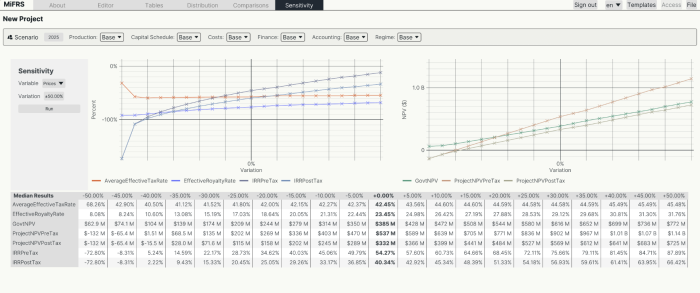
For example, a government could use MiFRS to rapidly test different fiscal regimes for a proposed mining project and see how they perform under different commodity prices, production levels, and project costs. The results can show how different combinations of royalties, taxes, and other fiscal instruments affect government revenues, investor returns, and the distribution of benefits between government and investors. Comparing these outcomes across scenarios helps policy-makers identify trade-offs and assess which fiscal options are more resilient when project and market conditions change.
By preserving projects, fiscal regimes, and economic assumptions in a transparent and reusable environment, MiFRS allows users to revisit and update analysis as market conditions, project information, or policy priorities change. Over time, this can contribute to a shared knowledge base and strengthen institutional capacity by helping government officials and other stakeholders explore mining project economics and financial benefit sharing in practical terms.
MiFRS is designed to complement, rather than replace, expert judgement and existing modelling approaches. It makes fiscal analysis more accessible to government officials, civil society organizations, researchers and development partners, supporting more informed discussions about mining fiscal policy and the trade-offs between different fiscal options.
ARPL and the IGF invite stakeholders to explore MiFRS, apply it to real analytical and training questions, and help shape its continued development. The platform, accessible from September 18, will be officially launched at the 2026 Extractive Industries Transparency Initiative Global Conference in Brussels during the partner session, Modelling What Matters: Using Data and AI to Mobilise Extractive Sector Revenues. It will also form part of the IGF Mining Academy, to be launched at the 2026 IGF Annual General Meeting.
Stakeholders can register for free through ARPL to access MiFRS today. They can also contact ARPL (Jonah Allen, jonah.allen@arplab.org) and IGF’s Global Mining Tax Initiative (Viola Tarus, vtarus@iisd.org) to discuss a demonstration, training exercise, or potential application of the tool.
Note: A French version of the tool will be available shortly.