
Critical minerals are at the centre of the global policy agenda. Governments are rolling out industrial strategies, forming security partnerships, and introducing due diligence legislation and financing mechanisms to secure supplied.
But responsible production is not yet the norm. Standards are applied unevenly across supply chains, and market incentives often fall short—leaving responsible operators at a disadvantage. In many countries, policy ambition is also outpacing the capacity to implement it.
Discussions on critical minerals are increasingly dominated by supply security and geopolitical considerations.
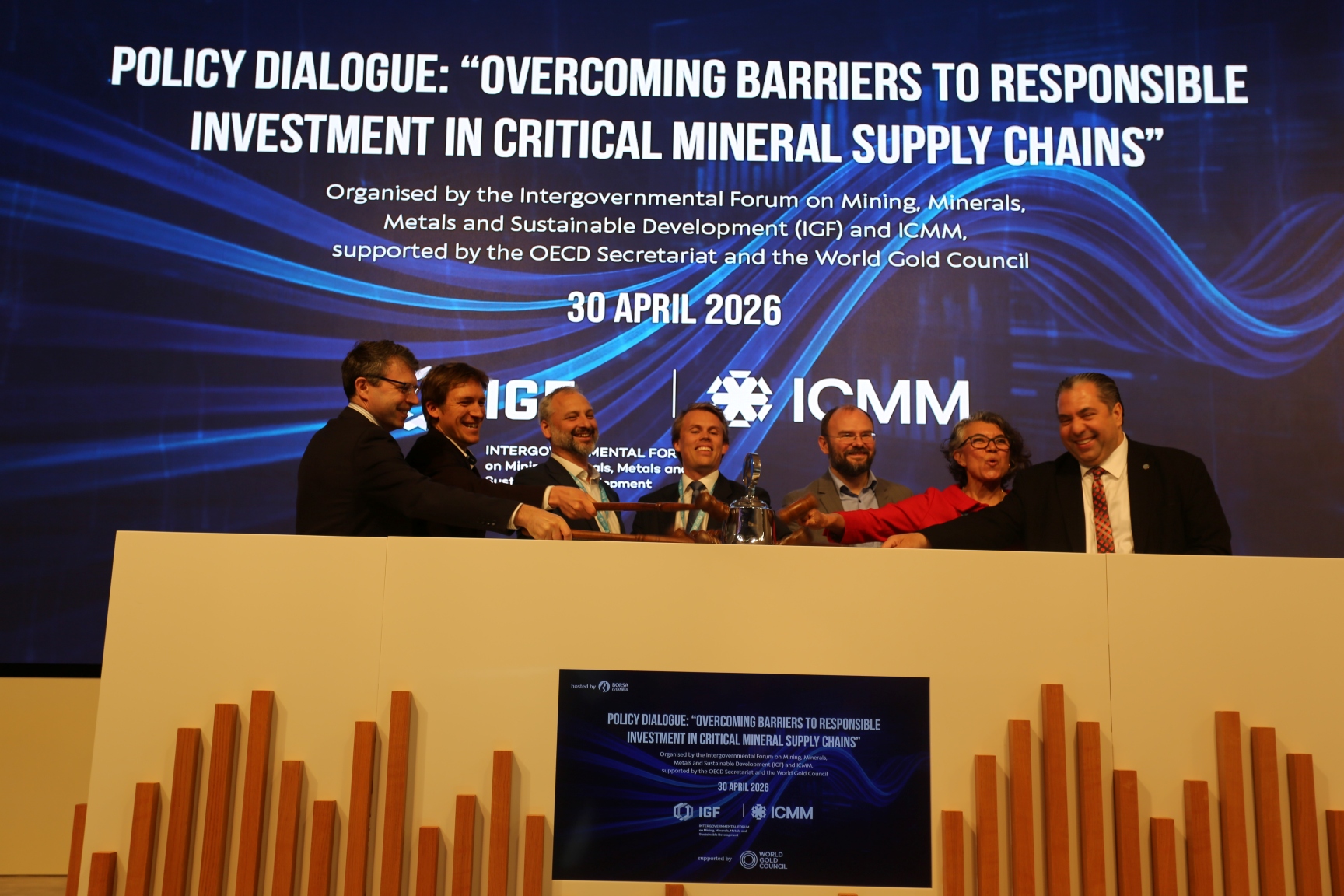
To address this, the IGF, together with ICMM, hosted a policy dialogue on the margins of the OECD Critical Minerals Forum 2026 in Istanbul. The dialogue created space to re-anchor the debate around implementation challenges and system-level barriers, rather than high-level commitments.
Over 40 senior decision-makers from the public sector, industry and civil society attended the event under Chatham House rules, sharing perspectives to identify priority barriers and possible ways forward towards actionable solutions for responsible investment in critical mineral supply chains.
Key Takeaways
- Responding to a pre-event survey, participants noted progress in the evolution (82%) and implementation (63%) of responsible mining standards over the past five years. This is despite geopolitical upheavals shifting political attention from sustainability to security of supply.
- Professionals from industry associations, civil society and governments largely agree that many sustainability standards are good on paper, though weaker standards may lower the floor for everyone. Regulatory enforcement gaps were seen as the main barrier, followed by the misalignment of incentives between upstream, downstream and financial actors as well as the fragmentation of the standards landscape.
- This confirms a key structural issue where the challenge is not the availability of standards, but the political economy of their implementation. Participants consistently highlighted that responsible actors often face cost disadvantages, while markets and regulatory systems do not systematically reward higher standards performance.
During the solutions-focused brainstorming session, participants worked in small groups to identify practical ways a multi-stakeholder platform could help address three persistent barriers in the mining and minerals sector.
Strengthening Regulatory Enforcement
Participants highlighted several approaches to address gaps in regulatory enforcement:
- Promoting cross-jurisdictional peer learning among producing countries
- Providing recognition or incentives for operations in well-regulated jurisdictions
- Involving affected communities in monitoring and accountability mechanisms
- Enhancing dialogue and alignment between private standards bodies and government regulators
Aligning Incentives Across the Supply Chain
To address misaligned incentives between upstream and downstream actors, participants prioritised the following ideas:
- Establishing mandatory downstream contributions to finance responsible sourcing upstream, particularly at the mine-community level
- Conditioning public and private financing on adherence to recognised standards
- Supporting wider adoption of the UN Transparency Protocol (UNTP) to improve data interoperability
- Making better use of due diligence data in investment screening processes
Reducing Fragmentation in the Standards Landscape
Participants also explored ways to address the proliferation of standards and frameworks:
- Aligning standards with core human rights and environmental principles
- Strengthening cooperation among standards-setting bodies
- Leveraging the UNTP to improve interoperability and comparability of standards and data
- Advancing comparability while recognising the need for tailored, sector-specific approaches
Together with our partners, the IGF is committed to building on the collective priorities identified through the cross-sectoral discussions in Istanbul.